
 Nöbetçi Eczaneler




In recent years, the nature of military conflicts has been shifting. Tanks are being replaced by unmanned aerial systems (UAS); instead of trench warfare, we’re seeing electronic warfare governed by algorithms. One of the most visible arenas of this transformation is the Iran–Israel axis. The heightened tensions in late 2024 and the first half of 2025 once again revealed the drone warfare capabilities of these two regional powers.
So, how advanced are their drone capabilities? In terms of technology, strategy, and effective deployment, who leads? Here’s a comparative look at the drone systems of Iran and Israel:
Iran’s cost-focused drone strategy
Iran has built its drone doctrine around low-cost, high-volume production. In particular, its Shahed-131 and Shahed-136 loitering munitions gained prominence during the Russia–Ukraine war, albeit indirectly. These kamikaze drones lack advanced sensors and precision targeting systems but are designed to saturate target areas by being deployed in large numbers. Iran’s strategy is based on overwhelming modern air defenses through sheer volume, aiming for tactical attrition rather than surgical precision.
The use of commercial components allows Iran flexible manufacturing but also introduces operational vulnerabilities. Low accuracy, susceptibility to electronic jamming, and unreliable navigation systems limit their effectiveness. However, their long-range capability and low production costs enable Iran to deploy these systems widely through its proxy network across the region.
Israel’s high-tech drone doctrine
Israel’s drone program is defined by advanced engineering and integrated defense systems. Platforms like the Heron, Harop, and Hermes stand out for their success in reconnaissance, surveillance, and strike missions. Features such as AI-assisted targeting, high-resolution electro-optical sensors, and real-time data sharing make Israeli drones not just tactical tools, but strategic assets. Many of these systems are also widely exported.
The downside of this high-tech approach is the relatively high cost of production and operation. As a result, Israel uses fewer drones but designs them for targeted, high-precision operations. Fully integrated with multi-layered air defense systems, these drones offer a flexible and powerful capability for both offense and defense. This approach places Israel among the nations using fewer but more effective UAVs.
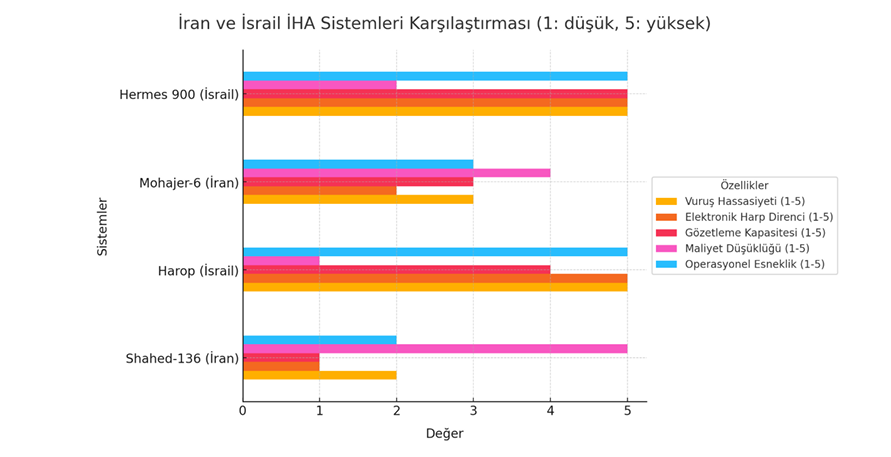
The UAV/drone systems that are both the most prominent for Iran and Israel, and that they actively used, especially in attacks against each other during the 2024–2025 period.
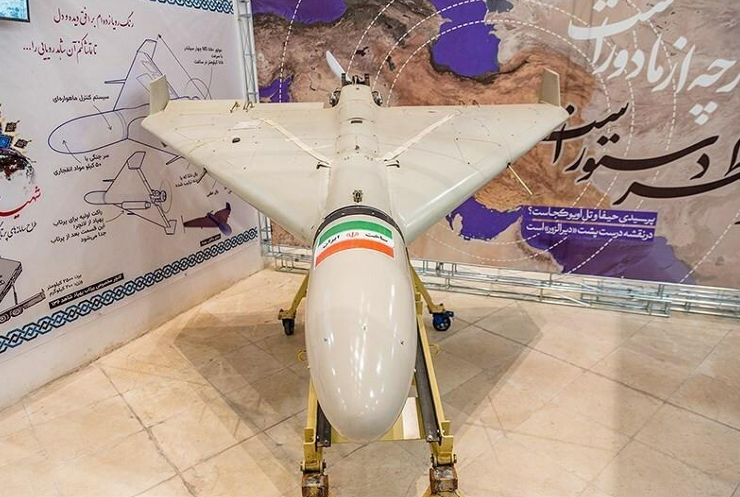
Key drone systems used by Iran and Israel (2024–2025)
Iran’s leading drone systems
1. Shahed-136 / Shahed-131 (Kamikaze UAV)
-
Use: Hundreds were deployed during Iran’s direct attack on Israel in April 2024
-
Range: ~2,000 km
-
Speed: 185 km/h
-
Warhead: Explosive payload aimed at degrading infrastructure
-
Guidance: GPS-assisted; low accuracy
-
Strength: Low cost, numerical advantage in swarm attacks
-
Weakness: Vulnerable to electronic warfare and air defenses
2. Mohajer-6 (Armed Tactical UAV)
-
Use: Deployed via proxy groups in Lebanon, Iraq, and Yemen against Israeli targets
-
Armament: Capable of carrying missiles and bombs
-
Surveillance: Medium-resolution optics
-
Strength: Dual-purpose (recon + strike)
-
Weakness: Limited operational precision and altitude ceiling
Israel’s leading drone systems
1. Harop (Loitering Munition / “Suicide Drone”)
-
Use: Precision strikes on targets in Syria and Iran (2024–2025)
-
Range: ~1,000 km
-
Speed: 185–250 km/h
-
Targeting: Electro-optical and RF homing head to detect enemy radars
-
Strength: High accuracy, loitering capability allows in-flight decision-making
-
Weakness: Expensive for mass deployment
2. Hermes 900 (MALE – Medium Altitude Long Endurance UAV)
-
Use: Extensive intelligence and strike missions in Gaza, Lebanon, and Syria
-
Endurance: 36+ hours
-
Armament: Precision-guided munitions
-
Surveillance: High-res EO/IR cameras and signals intelligence
-
Strength: Integrated with network-centric warfare, multi-role use
-
Weakness: Long time-on-target creates dependency on ground control
Conclusion:
Iran heavily relies on kamikaze and semi-recon drones, primarily operated through proxy networks. Its strategy centers on overwhelming Israeli air defenses with mass attacks. However, there remains a significant technological gap compared to Israel.
Israel, by contrast, uses fewer but far more precise and intelligent systems, capable of surgical strikes on high-value targets such as radar and command centers, especially with drones like the Harop. Israel’s biggest advantage is its ability to integrate drones with a robust intelligence and defense network, creating a formidable combined force.
Ultimately, the two drone doctrines resemble different chess pieces: Iran advances its pawns en masse, attempting to control the board through volume, while Israel positions a few high-value pieces to directly threaten the king.