
 Nöbetçi Eczaneler



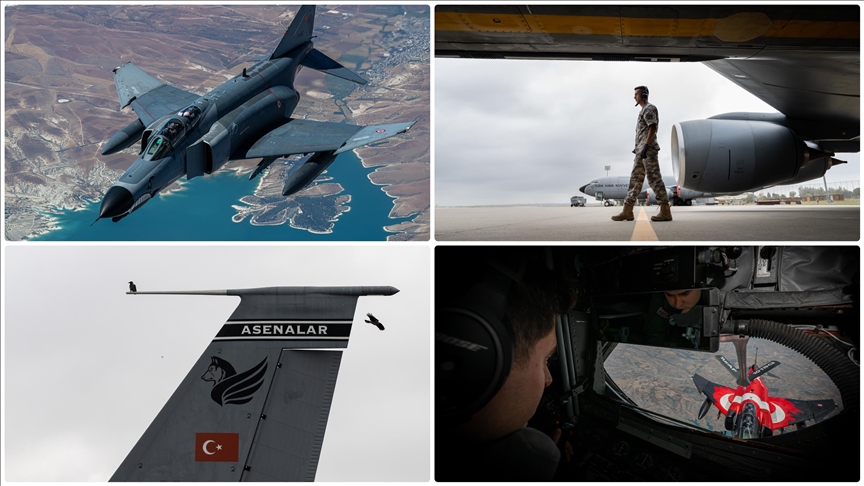
Based at the 10th Main Jet Base Command, the 101st In-Flight Refueling Squadron—widely known as the “Asena Squadron”—can refuel an F-16 mid-air in just about 3 minutes using its KC-135R Stratotanker aircraft. These tankers, part of the Turkish Air Force’s fleet stationed in Incirlik, Adana, provide uninterrupted flight capabilities by conducting aerial refueling at an altitude of 26,000 feet and a speed of 950 km/h.
Anadolu Agency (AA) captured the entire process, from the squadron’s pre-flight preparations to the aerial refueling of F-16 and F-4E/2020 Phantom fighter jets.
Before the flight, the aircraft commander held a briefing with the team to review the route and technical details of the aircraft to be refueled.
The flight crew then moved to the runway and received a technical briefing on the KC-135R Stratotanker. After final checks by the aircraft commander, the crew took their positions onboard and the aircraft took off.
Asena Squadron Meets Fighter Jets in the Skies
Once over Diyarbakır, the tanker aircraft first rendezvoused with an F-4E/2020 Phantom and then with F-16 fighter jets.
At 20,000 feet and 650 km/h, the Phantom approached the rear of the tanker aircraft. Before the refueling, the “boom” operator took position and initiated radio contact. The Phantom opened its refueling hatch and carefully approached. The boom operator extended the fueling nozzle and connected it to the open port of the fighter jet.
Later, the crew refueled two F-16s mid-flight while maintaining a speed of 950 km/h. Refueling was completed swiftly, allowing the jets to continue their missions.
The operation lasted around four hours. Once complete, the Asena Squadron safely returned to base at the 10th Main Jet Base Command.
Critical to Sustained Combat Operations
Colonel Gönen, Commander of the 101st In-Flight Refueling Squadron, said their primary mission is to extend the endurance of fighter jets and airborne early warning and control (AEW&C) aircraft, allowing them to perform more missions in critical areas.
He emphasized that the KC-135R aircraft are long-range, high-altitude, high-speed, four-engine jets, constantly modernized with advanced avionics systems. In addition to refueling, they also carry cargo and can support missions far beyond the home base, including international deployment.
Refueling Explained
Senior Master Sergeant Kasapoğlu stated that they refuel combat jets from just 3 meters away, transferring 1 to 1.5 tons of fuel per minute, day or night, with utmost safety.
He also shared that the aircraft can carry up to 18 tons of cargo and 100 passengers, supporting NATO operations and overseas exercises by refueling fighter jets without the need for landing.
During turbulent weather or cloud cover, refueling requires extreme caution and precision. The squadron trains for emergencies through simulations and keeps its combat readiness at the highest level.
One Minute of Fuel Equals a Year of Car Fuel
The boom system at the tail consists of telescoping tubes that extend up to 14 meters. In one minute, the tanker transfers enough fuel to power a car for a year. Its rubber can produce 100 car tires. The maximum fuel load equals a car’s 46-year consumption. In 8 minutes, the aircraft delivers the same fuel volume a gas station pump would provide in 24 hours.
Refueling an F-16 Takes Just 3 Minutes
Asena Squadron, one of the Turkish Air Force’s most strategic units, dramatically increases fighter jets’ range and endurance. Using KC-135R Stratotankers, they can refuel an F-16 in just 3 minutes.
Strategic Role in Cross-Border Operations
The squadron plays an active role in Turkey’s cross-border operations and also supports the 401st Test Squadron during test flights. Their crews constantly train to enhance readiness for demanding missions.
With the capability to travel intercontinentally with about 100 tons of fuel, the tanker aircraft can also transport 18 tons of cargo on 6 pallets and carry up to 100 personnel.
Due to their strategic importance, few countries operate such tankers. Turkey is among the select few with Stratotanker aircraft in its inventory. This fleet significantly boosts Turkey’s border security and plays an important role in NATO missions, offering a valuable resource to allied nations.